
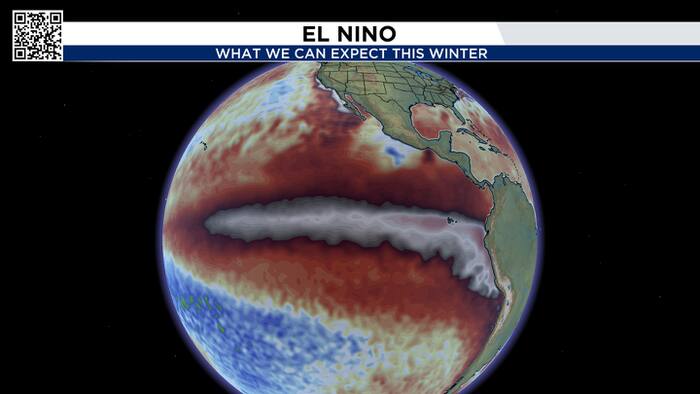
I’ve received a lot of questions about this upcoming winter and how this incredibly strong El Niño will affect it. In today’s article I’m going to give an overview of what El Niño is and how it typically affects the United States winter and Texas specifically. Tomorrow I’m going to focus on impacts to Houston from December to March.
The definition of El Niño is simple. It is warmer than average temperatures in the Central Pacific Ocean. It’s a natural climate pattern that influences weather patterns around the world.
Normally, trade winds blow from east to west across the Pacific Ocean. These winds push warm water toward Asia and Australia, allowing cooler water from deeper in the ocean to rise near the coast of South America.
But every few years, those winds weaken. When that happens, warm water that normally stays in the western Pacific spreads eastward across the ocean.
That warming of the central and eastern tropical Pacific is what we call El Niño.

The name first came about in the 1600s. Fishermen from South America noticed an irregular warming of ocean waters off the coast peaking in winter, specifically December. The fishermen called it El Niño de Navidad, which translates to “The Christmas Child.”
This warm water affected more than the fishermen. When the waters are warm in this area it becomes a heat engine which can shift the jet stream and influence weather patterns around the world.
Here’s where things get interesting.
El Niño isn’t unusual. It happens every 2 to 7 years. What makes this one different is how unusually warm the Pacific Ocean has become and how quickly this event has strengthened.
According to NOAA’s October 2026 update, this El Niño is potentially the strongest one observed since records began in 1950.
Some areas of the eastern tropical Pacific are more than 7 °F warmer than average. That’s a remarkable amount of extra heat in the ocean!
And this El Nino is expected to remain incredibly strong and last through winter. And this will have an impact on our December to February forecast.

El Niño doesn’t tell us exactly what the weather will do on any particular day. Instead, it changes the odds of certain weather patterns.
For Texas and the Gulf Coast, El Niño often means:

And of course, it greatly affected this year’s hurricane season. Because of El Niño the preseason predictions were for a less active Atlantic hurricane season. And that is exactly what we got! El Niño hurricane seasons typically bring strong upper-level wind shear over the main development region of the Atlantic, making it harder for hurricanes to develop and strengthen. This hurricane season only one hurricane formed with nine tropical storms, this is below the average of fourteen named storms in a season.

Weather patterns shift throughout the world. And more than just wet and dry, the wet areas in green can get incredible flooding. The tan areas below can enter into devastating droughts.

El Niño is a giant shift in the distribution of heat across the Pacific Ocean. That shift changes atmospheric circulations and can influence weather around the world.
What makes the current event so unusual is the sheer amount of extra heat in the Pacific, both at the surface and below it, and the potential for this to become one of the strongest El Niño events in modern records.
Coming Thursday I’ll give my winter forecast and what this particularly strong El Nino will bring regarding temperatures, precipitation and if we’ll get snow this winter in Houston. We’ll take a look back at other incredibly strong El Niño’s and if we can learn anything from them. Make sure you are subscribed to this newsletter by clinking the image below.


